Our Specialty: Helping Customers Go from Schematic to Finished Product
Cast Aluminum Solutions serves companies worldwide with highly-engineered thermal products and industrial components. Our company makes products that help save lives, connect the world, protect our country and cook the world’s most popular foods.
Engineering Expertise is the foundational component to our value delivery approach. Consisting of a very experienced team of mechanical engineers, electrical engineers and thermal technicians, the CAS Engineering department utilizes state-of-the-art design technology and a fully-equipped Research and Development Laboratory to create initial designs, test their functionality via computer modeling before manufacturing, and then, after the prototypes are made, to test the first articles for reliability and performance.
Examples of the design software our engineering team uses include the Solidworks 3-D computer-aided design (CAD) application. Finite Element Analysis (FEA) is another very important application used by CAS Engineers. FEA allows CAS Engineers to create both thermal models and structural models. Thermal models are primarily aimed at (A) ensuring the component CAS is making achieves the desired target temperature (which ultimately ensures the customer’s required Delta-T, or change in temperature, can be met, leading to proper processing of the substrate, liquid, or gas in question), and (B) our thermal models aim to achieve consistency across the face of the heated component CAS is designing. Especially on flat heated surfaces, thermal consistency can be just as important as peak temperature. CAS Engineers also utilize FEA applications to construct structural models. Structural models can be tied to heating simulations, effectively allowing technicians to see how heat affects physical characteristics. Because the CAS Engineering department thrives on efficiency, they have the ability to link their 3-D CAD models to thermal and structural simulations, so when a design is changed they can automatically re-run the heat-transfer and structural portions of the modeling exercise.
The primary goal of these extensive modeling and design phases is to work out any and all design flaws before prototypes are made. Some of the variables CAS Engineers will augment in their modeling exercises include: heater and flow-tube shape, heater and flow-tube bend pattern, heater and flow-tube location within the larger component, heater wattage and operating temperature, the physical geometry of the heated component, and small variables such as surface groove patterning, mounting bracket dimensions, and the location and construction of any attached accessories, thermocouples, sensors, or electrical enclosures.
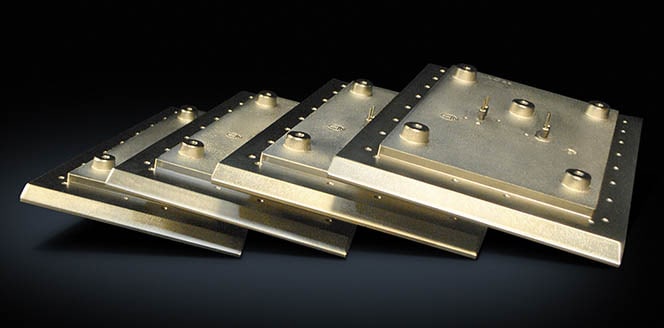
Once our engineers arrive at a point where the thermal and structural models meet the customer’s desired parameters, final approval schematics and STEP files are generated. If all involved parties agree upon the design specifications, preparations can be made for building prototypes. This might include ordering heaters, flow-tubes, sensors, compression fittings and of course, substrate material. CAS offers a number of substrate options, including several aluminum alloys, multiple grades of stainless steel, and specialty metals such as Incalloy, Monel, copper, titanium, and so on.
If casting the prototype, CAS offers tilt-pour casting methods and pressure casing methods. Both offer outstanding product quality, low porosity, and the ability to cast flow-tubes, heating elements, and thermowells into the molded component. Sand casting options are also available for prototyping. If casting is not desirable for the prototype, CAS offers our proprietary IFC (interference fit construction) technique. With this method, heaters and tubular components are fit into a milled groove on the substrate; and IFC has the ability to accommodate a wider variety of substrates than our casting procedures might.
After initial bodies for prototypes are successfully fabricated, they may be machined at one of CAS’s multi-axis machine centers. If welding or joining procedures are required, customers can choose from many options, including MIG and TIG welding, vacuum brazing, electron-beam welding, and more. If special surface finishes are required, CAS can also accomplish this, offering an array of anodizing, powder coating, and synthetic options. Final assembly and cleaning usually go hand-in-hand with surface finishing, and these represent the final steps in building a prototype.
When the final prototype has been completely assembled, it is ready to return to the hands of the CAS Engineering Team, and here, just as in the design phase, a number of advanced technologies are employed. CAS offers X-Ray and ultrasound imaging to verify the placement of heating elements, flow-tubes, and other components within the casting. Flow-tube positioning is especially important to the performance of our CAST-X Circulation Heaters and semiconductor pedestal heaters that might feature flow-tubes (which, in those circumstances, often serve to carry cooling fluids). Infra-red cameras, accompanied by extensive data-logging, are sometimes used by CAS Engineers to test for thermal uniformity. The reliability of prototypes is often checked using our variable-voltage life-cycle testing station. Helium leak tests may also be performed at CAS: this type of test is important for components to be installed in a vacuum chamber environment. For testing the heating capabilities of components destined for vacuum chamber installations, the CAS Research & Development Lab is equipped with a large vacuum chamber capable of accommodating semiconductor pedestal heaters and platens up to 450 mm.
Many of the tasks associated with developing and testing prototypes are in the hands of the CAS New Product Development Team. This team includes portions of our engineering staff, plus machinists, technicians, and project managers.
The second tenet that continuously propels CAS forward is the Speed to Market principle. CAS serves a number of tech-heavy, economically-vibrant industries. As a result, our customers tend to demand quick turnarounds, expedited performance, and a steady supply of next-generation components in the development pipeline. One of the primary business facets that our speed to market directive steers lies in our production department, which is essentially the volume manufacturing side of our business.
For products that are in production – those that have moved beyond the prototype stage and are in demand via orders from OEM accounts – it is essential products are developed, manufactured, tested, packaged and shipped on time. This may sound simple – but when one considers the complexity of our products, the multiple steps needed to make them, and the outside services that often come into play – it is easy to understand that staying on timeline requires sophisticated tracking tools, excellent personnel management, and a deliberate focus on job progression.